Transpose to sing in your own key
Your voice doesn't sit right with the handpan? Shift the anchor note in one move and change key to sing at your natural pitch.
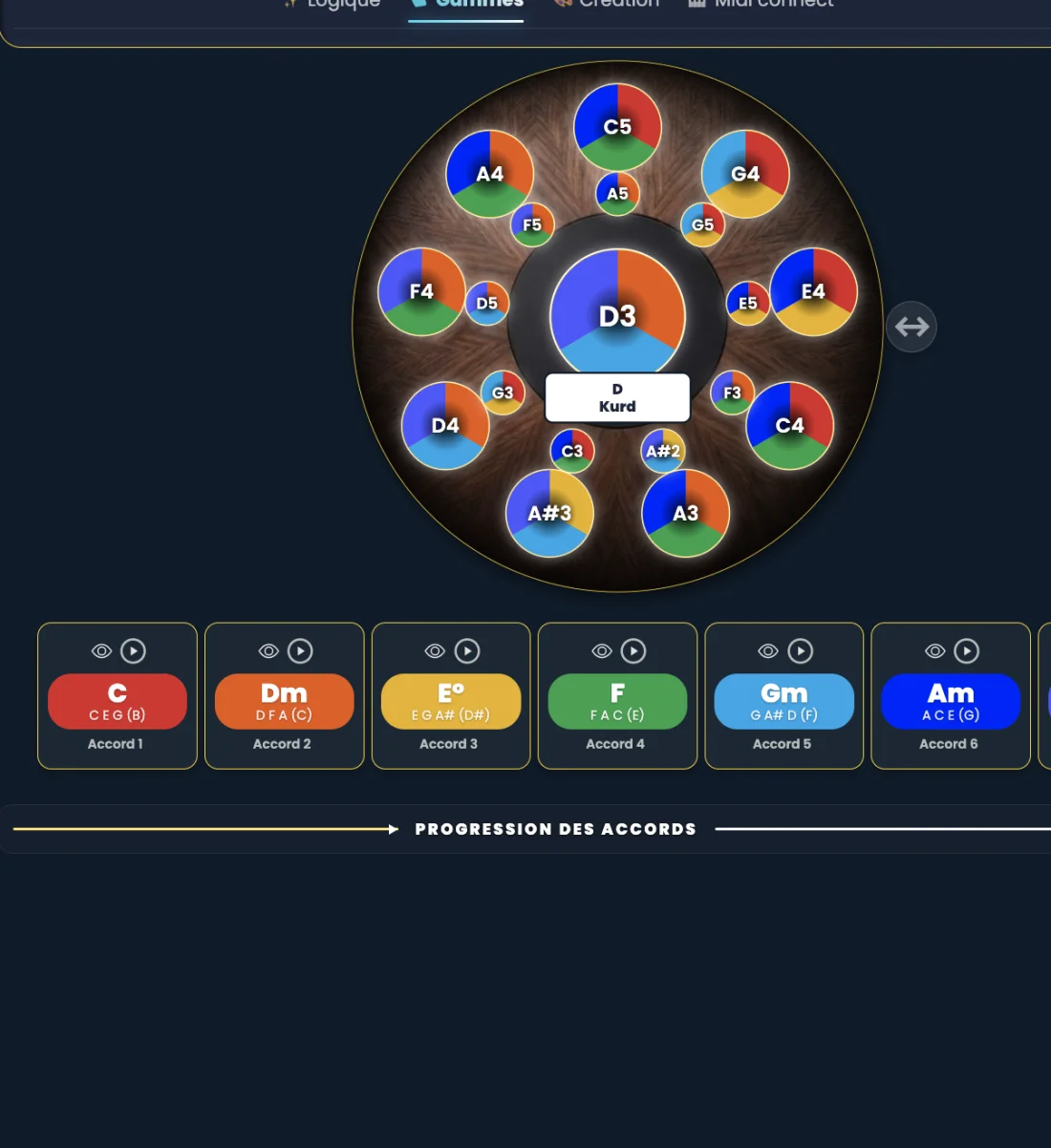
Transposing means shifting your handpan’s anchor note to change key in a single move. If a song is too high or too low for your voice, you don’t have to strain: in Handpan Studio, you slide the whole thing to your natural pitch, and everything falls into place — accompaniment and singing in your key.
The real problem: your voice has its pitch
A song is written in a given key, designed for the singer who first performed it. Yours is unique: what’s comfortable for one person is sky-high or cavernous for another. Forcing a note too high tightens the throat; aiming too low makes the sound vanish. The result is frustrating, when the problem isn’t your voice — it’s the key.
On an acoustic handpan, the key is fixed: it’s tuned once and for all. You can’t move it to match your voice. This is one of the great freedoms digital opens up.
One move, a new key
In Handpan Studio, shifting the anchor note is enough to change key. You move the reference point, and the whole layout follows: the chords, colours and emotions stay identical, only the pitch changes. The Logic Mode grammar is preserved — you find your degree I, your V, your VI in exactly the same place under your fingers, but in a new key.
In practice: you sing a phrase, it’s too high, you drop the anchor a few notches, you try again. In seconds, you find the pitch where your voice settles effortlessly. The song sits right, and so does the accompaniment.
Singing in tune without “singing off-key”
Many people believe they “sing off-key” when they’re simply singing in a key that’s wrong for them. By transposing, you move the target into your comfortable zone — and often, accuracy comes back on its own. It’s not cheating, it’s what every professional accompanist does when adapting a piece to a singer.
Transposition and layout: the winning duo
Transposition sets the pitch; the vocal layout sets the shape of the accompaniment around the voice. Together they mould the song around you: you pick a vocal layout suited to your range, then transpose until it lands just right. That’s the full setup for accompanying your own singing.
Sing at your own pitch
There’s no reason to twist your voice to fit a key that isn’t yours. Move the anchor, find your pitch, and let the song come to you.
Want guidance to accompany your own singing? David Lesage’s lessons take you by the hand. Open Handpan Studio and transpose your first song into your key.
Ready to make your colours sing?
Try the app for free, or discover the electronic Neotone handpan.