Playing with emotions: the 7 coloured degrees
Handpan Studio's Logic Mode ties each degree to a colour and an emotion. Build a chord progression and tell a story.
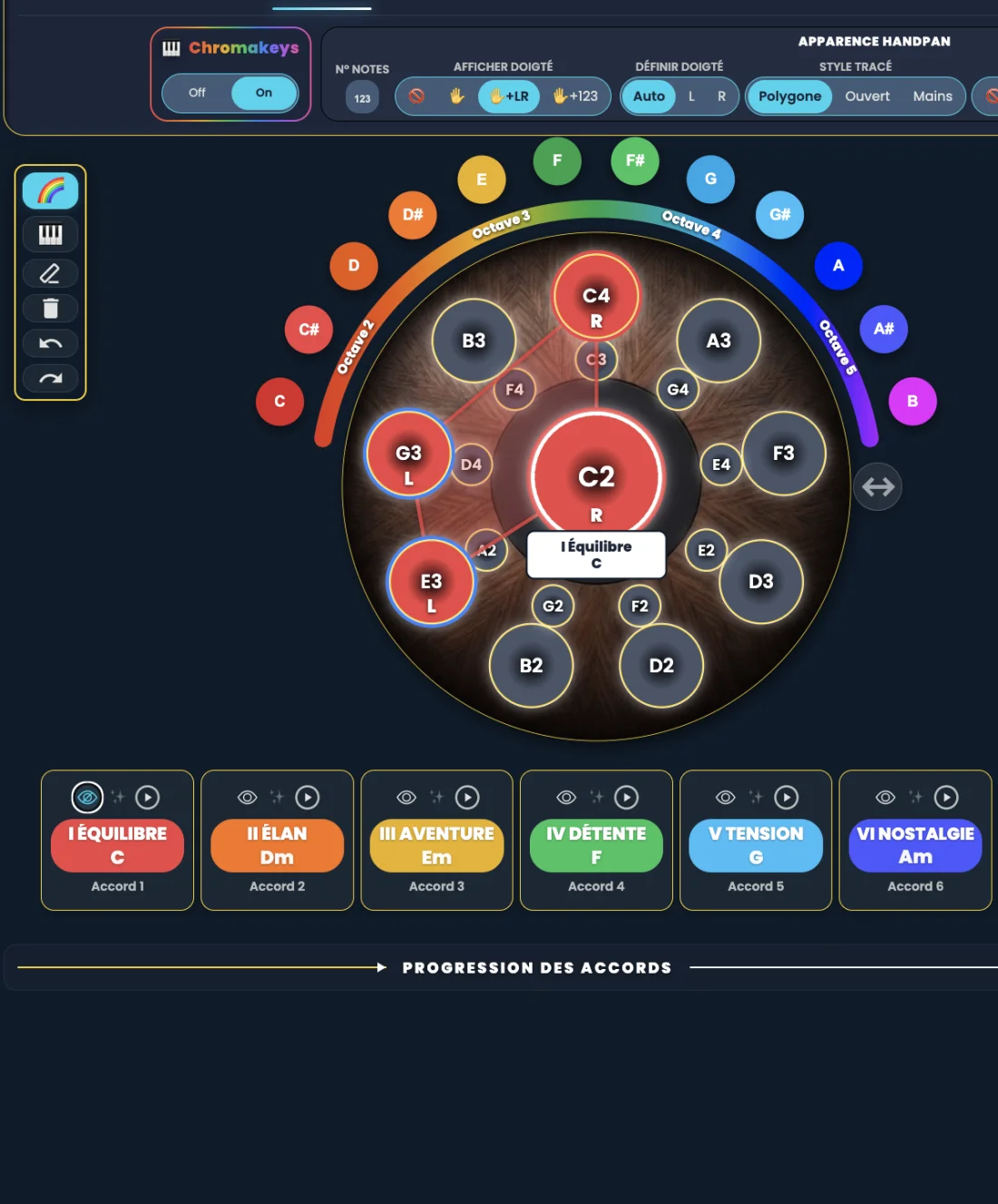
Handpan Studio’s Logic Mode treats music as a language of emotions. Each degree of a scale — the seven steps that make it up — gets a colour and an emotional tone: balance, momentum, gentle tension, coming home. You no longer choose notes, you choose what you want people to feel. And a sequence of degrees becomes a story.
Seven degrees, seven emotions
In a scale, every note plays a role. The first degree is the anchor, the place where things “settle”. The fifth creates momentum, the urge to go further. The sixth brings a nostalgic tint, the seventh a tension that calls for resolution. These roles are universal: they exist in almost all the music you love, even if you’ve never put words to them.
Logic Mode makes these roles visible by giving them a stable colour, following the ChromaKeys logic described in Playing handpan by colours. Degree I always keeps its hue, whatever your scale. You learn a grammar of emotions once and for all.
Building a chord progression
Choosing by emotion
Instead of asking “which chord comes next?”, you ask “where do I want to go emotionally?”. Want comfort? Return to degree I. Openness? Go through the V. Melancholy? The VI. Logic Mode lets you chain these degrees while seeing, in colour, the emotional trajectory you’re drawing.
Telling a story
A progression is a little tale: a departure, a tension, a return. Many pieces that move you rest on just three or four chords. By placing your degrees the way you place the beats of a story — calm, momentum, doubt, peace — you compose something sincere without a single notion of music theory.
A suggested fingering, not a rule
In electronic Logic Mode, the app can offer you a suggested fingering to chain notes cleanly. It’s a help for the gesture, not a rigid instruction: your hand stays free, the suggestion just keeps you from tensing up.
From emotion to a piece
Once you feel how the degrees talk to each other, everything opens up. You can visualise your chords as Constellations, switch scales through the Sound Atlas, or bring these colours onto an electronic Neotone handpan where screen and instrument speak the same language.
Want to be guided step by step through this grammar of emotions? David Lesage’s lessons take you by the hand, at your own pace. Open Handpan Studio and compose your first phrase — not with notes, but with emotions.
Ready to make your colours sing?
Try the app for free, or discover the electronic Neotone handpan.