The music library: what if your scale told you what to play?
Songs to accompany, handpan pieces, your own compositions: Handpan Constellation Studio's library tells you which ones your scale can actually play.

Handpan Constellation Studio’s music library (Bibliothèque musicale in the app, still labelled in French) gathers in one place the songs you can accompany, the handpan pieces and your own compositions. But its real talent lies elsewhere: it looks at your scale and tells you, piece by piece, what your instrument can play — and what it can’t.
That calculation runs on the real notes of your scale, whether your handpan is acoustic or electronic.
The question everyone asks
“Can I play this song on my pan?” It’s every handpan player’s first question, and for a long time the only answer was: try it and see. You feel around, you hit a wrong chord, you conclude you’re not good enough — when in fact the scale simply doesn’t contain the note.
That’s not a skill problem. It’s an information problem.
Two worlds, one door
The library opens from your account, and it sorts music into two families:
- 🎤 Songs — the ones you accompany on the handpan: Beatles, Cohen, anything sung around a fire.
- 🥁 Handpan pieces — the players’ repertoire, the music that stands on its own. That part is still being built: it will grow with the compositions the community leaves there.
A search box, filters by author, style or year, and four shelves: 🌍 the world repertoire, 🎨 the handpan repertoire, ✍️ your compositions, 🎼 other players’ compositions. One click opens the piece straight into the score editor.
The badge that changes everything
Every piece now carries a marker, computed from the real notes of your scale:
- ✅ playable as is;
- ✅ playable transposed;
- 🔓 playable with your 2nd handpan;
- 🥁 playable with another player;
- 🔒 notes are missing — and the app tells you which.
Counters at the top of the list give you the picture before you even start searching. On a D Minor / Kurd 10 the count is blunt: 156 pieces playable, 41 blocked. Both mechanisms live side by side — automatic transposition (« ✅ Jouable transposé en F ») makes playable whatever can be played in another key, while the amber badge (« 🔒 Il manque C# sur ton pan ») says plainly what does not fit.
Click the image to open it, then click again for full size.
A blocked piece still opens. Click it and the app doesn’t slam the door: it names the missing notes, tells you that you can go in anyway, then shows you what would complete your instrument — with numbers.
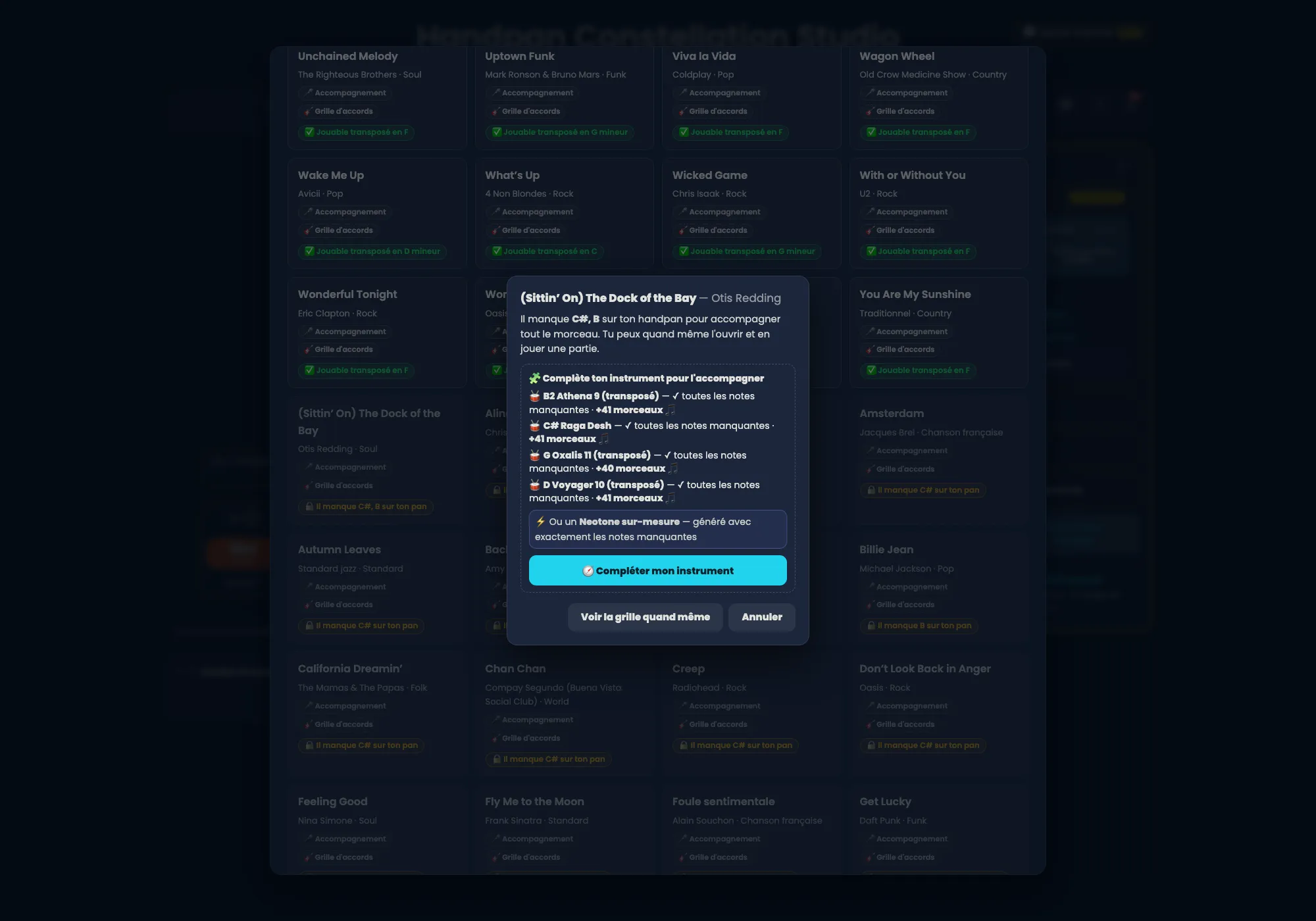
Click the image to open it, then click again for full size.
Neither a wall nor plain transposition: a door. The app says what is missing, offers a second handpan that fills exactly that gap — with the number of pieces gained —, and still lets you into the chart.
On an acoustic handpan the app goes further and offers the piece transposed into your pan’s key where that is possible — since the notes themselves will not move. On an electronic handpan, it is the instrument that goes to meet the key of the piece.
Your library follows you
Everything you create — pieces, scales, sets — is tied to your account and turns up on each of your devices: the computer in the living room, the iPad on the sofa, the phone on the train. Offline, the app keeps working and catches up on syncing as soon as the network is back. And if the same item exists in two places, the most recent version wins, without ever erasing anything.
That online backup is part of the Studio version; receiving and viewing shared content stays free.
A repertoire built together
A handpan library doesn’t really exist anywhere else yet. This one fills up gradually, with the scores each of us places, corrects and shares — in the same collaborative spirit as the feedback feature.
Open Handpan Constellation Studio, load your scale, and go see what it already knows how to play. You may be surprised. And if you’d like us to explore that repertoire together, my handpan lessons are there for that.
Ready to make your colours sing?
Try the app for free, or discover the electronic Neotone handpan.