Handpan microphone: my Muling MP1 + HMP-2 set
Amplifying an acoustic handpan without feedback: the Muling set, two magnetic pickups and an HMP-2 preamp. Contents, setup, power options and ordering.
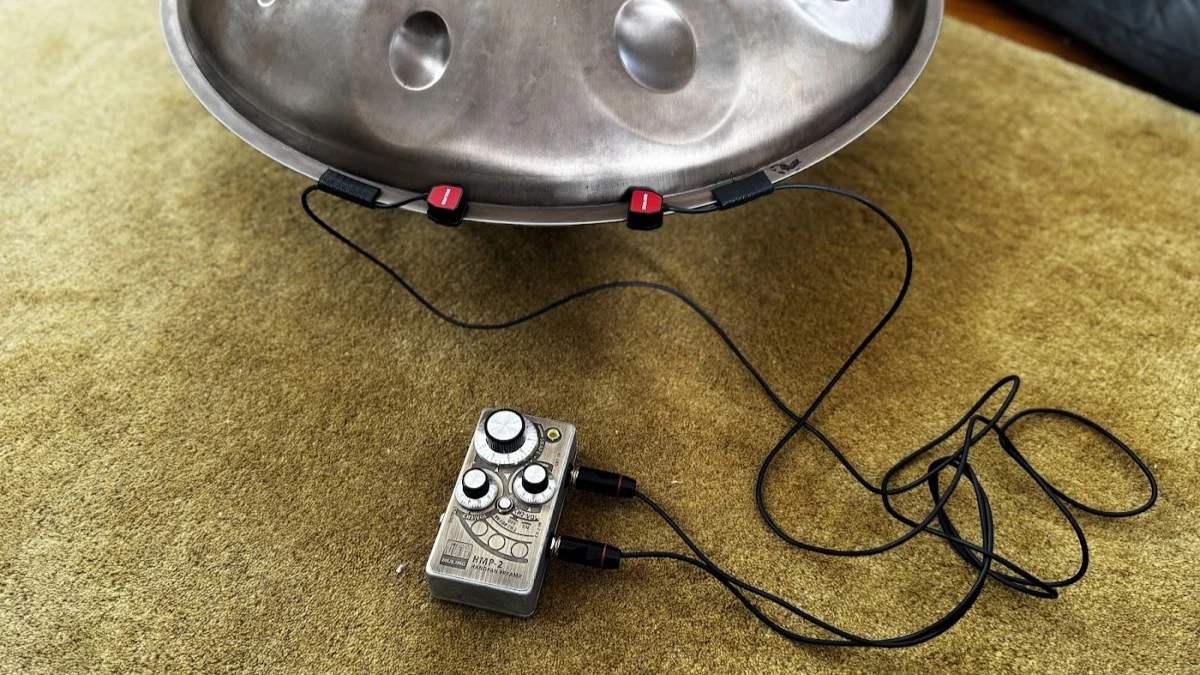
This article is about the acoustic handpan: it covers miking an instrument that has no jack output. An electronic handpan such as the Neotone plugs in directly, no microphone needed.
Amplifying an acoustic handpan is a real challenge. General-purpose mics capture the overtones poorly, and feedback creeps in as soon as you turn up the volume.
The Muling set is designed for this specific instrument. I tested it in depth. Here is how it works and how to set it up.
Why there’s no feedback
Feedback is the howl you get when a mic picks up the speaker’s sound and loops it back.
The MP-1 pickup is not an ambient mic. It is a surface condenser microphone: it captures vibrations in direct contact with the shell.
The result: outside noise and other instruments barely get through. You can turn up the volume on stage without fearing feedback, and the sound stays faithful even in a noisy venue.
What’s in the box
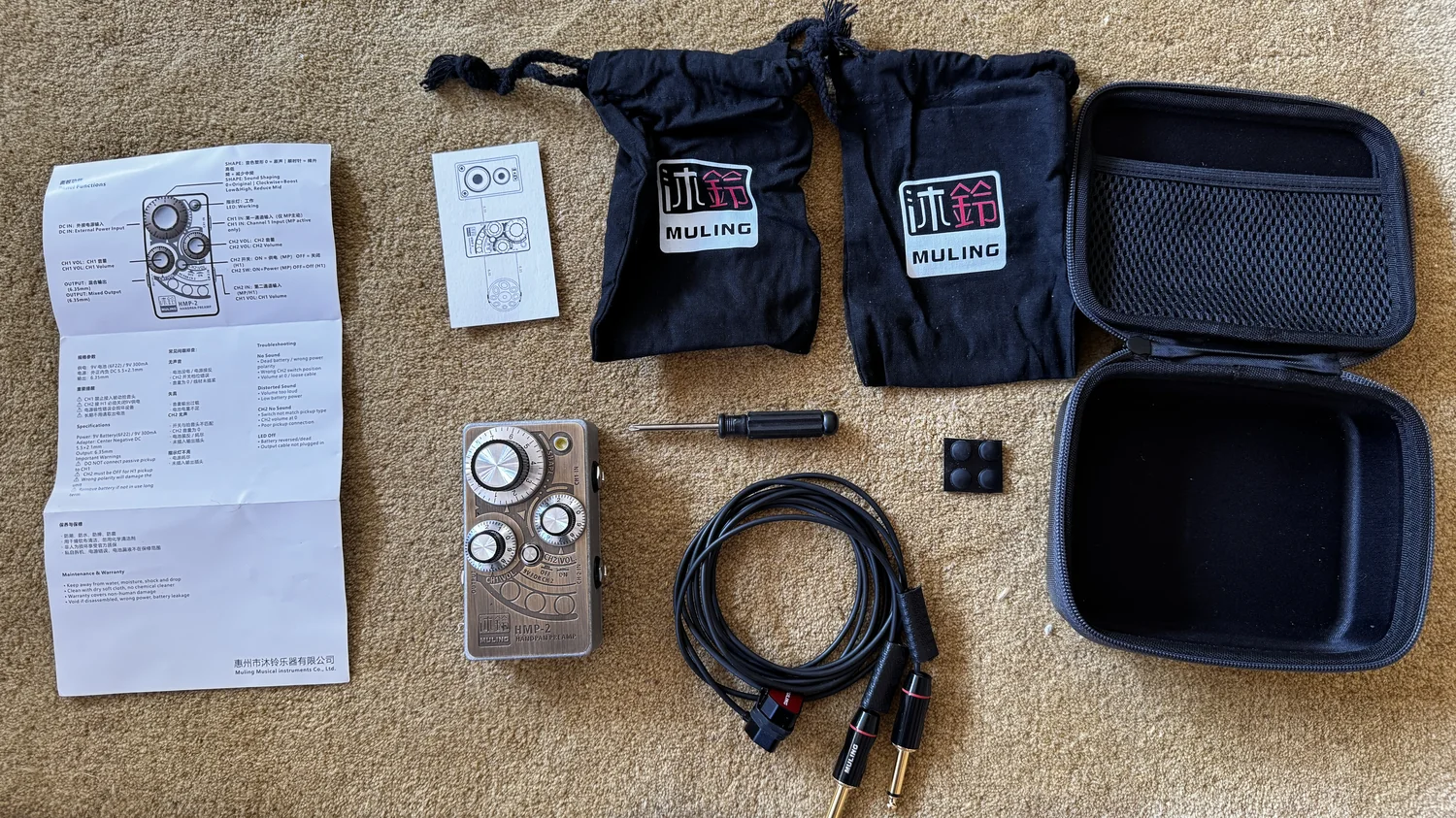 The whole set at a glance: the manual on the left, the preamp and its cables in the middle, the pouches and the hard case on the right.
- 2 magnetic contact pickups (active mics)
- 1 two-channel HMP-2 preamp
- 2 gold-plated 6.35 mm jack cables
- 1 hard carrying case and 2 fabric pouches
- 1 screwdriver to open the preamp (battery access)
- 4 adhesive mounting pads, cable clips
- the manufacturer’s manual
One set covers two handpans: one pickup per instrument, both mixed in the preamp. On a single handpan, you can place both pickups for a more balanced capture.
Setup, step by step
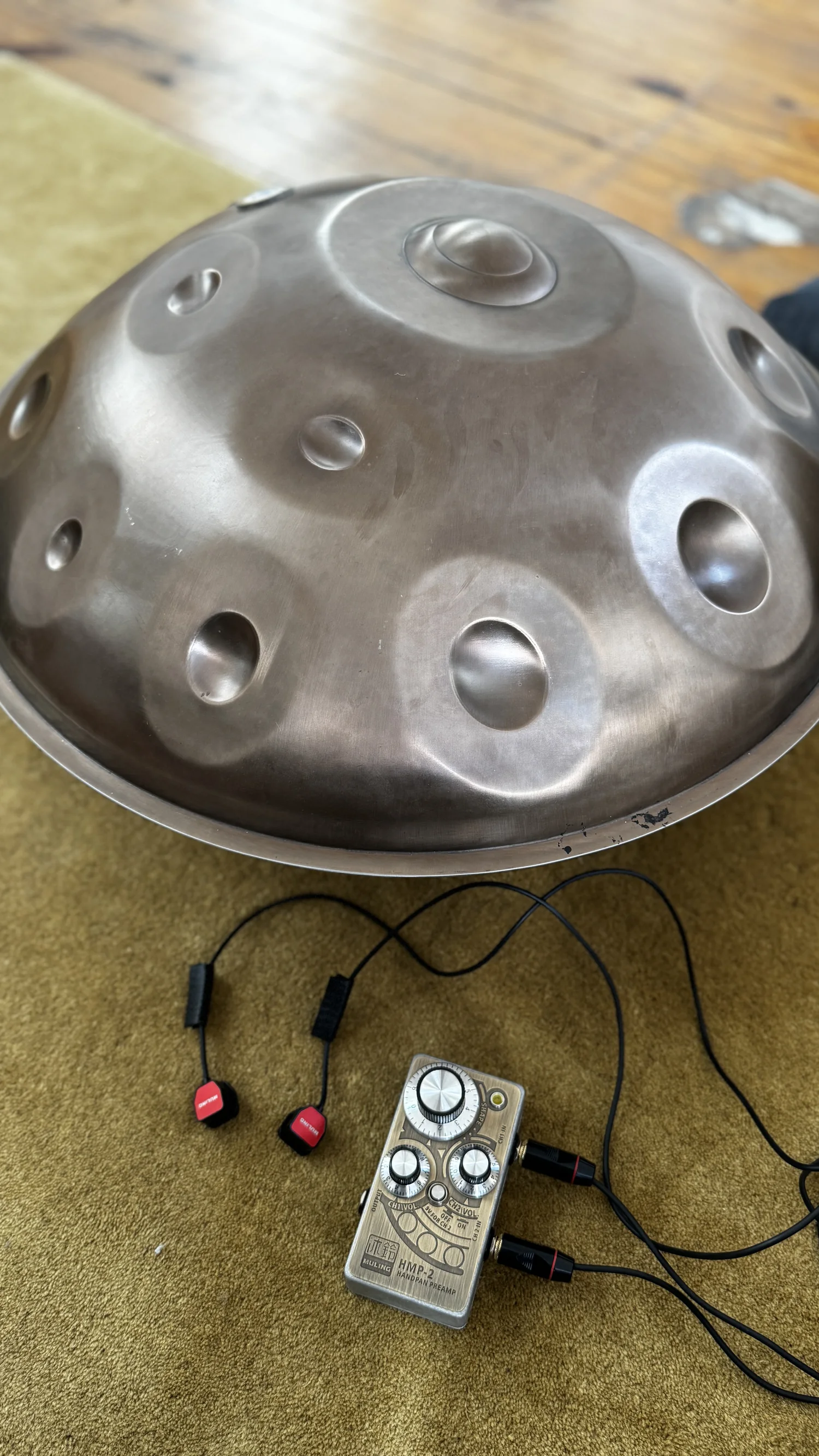 The complete system next to the instrument: two pickups, two cables, one preamp. Nothing else.
- Place the pickups on the shell. They hold by magnet: on and off in one move. They are the size of a fingertip and disappear while you play. The recommended positions are drawn in the supplied manual.
- Plug them into the preamp. The active pickup goes into CH1, the second into CH2 with the switch set to ON.
- Balance the two volumes. CH1 and CH2 each have their own knob.
- Go out with a single 6.35 mm jack cable to your speaker, mixing desk or audio interface.
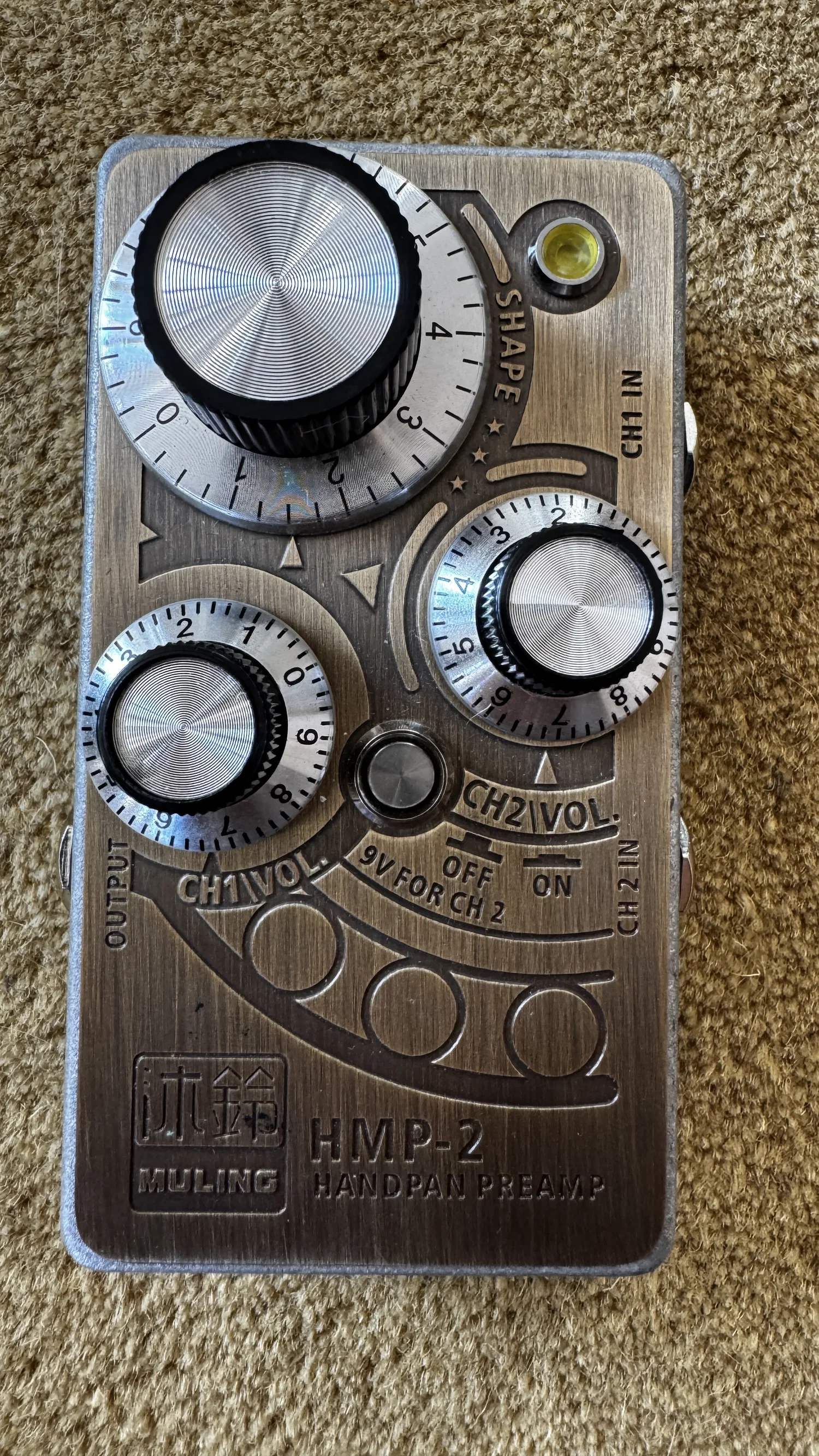 The preamp from the front. Note the large SHAPE knob at the top, the two volumes below and the small “9V for CH2” switch in the middle.
The SHAPE knob sculpts the sound. At 0, you keep the original tone. Turning it clockwise boosts lows and highs while cutting the mids: handy for cutting through a busy mix.
Battery or mains
- 9 V battery (6F22 type), housed inside the case: about 20 hours of playing, no power cable. I personally use a rechargeable battery.
- Mains: 9 V adapter, 300 mA minimum, 5.5 × 2.1 mm plug, centre-negative polarity. It is not included: buy it separately and double-check those figures.
Read before plugging in
These are the manufacturer’s warnings, not mere tips:
- Never plug a passive pickup into the CH1 input: it delivers power at all times.
- For an H1-type passive pickup, CH2 must be set to OFF.
- Reversed polarity on the mains adapter destroys the unit permanently.
- The pickups work only with the Muling preamp: it’s a complete system, not a pickup to add to an existing rig.
Not just the handpan
The pickup is a very sensitive surface microphone: it captures any acoustic instrument that vibrates, not only the handpan. Guitar, ngoni, harp: it works too.
On wood, the magnet won’t hold. You then attach the pickup with contact paste or mounting putty.
Compared with an AKG C411, another well-known contact mic: no residual noise, and no phantom power needed (the 48 V a mixing desk supplies), because the HMP-2 preamp powers the pickup itself.
My mobile setup with the Bose S1 Pro+
The preamp outputs on a single 6.35 mm jack cable. So it plugs straight into a standalone speaker like the Bose S1 Pro+, the one in my mobile setup. No mixing desk to carry.
What if you play an electronic handpan?
The Neotone doesn’t need a microphone: it plugs straight in by jack, into the same speaker. It’s all in my Neotone + Bose S1 Pro+ mobile setup.
Order or reserve your mic
The maker’s price is €258. With my code David-Lesage-5, you get 5% off: the set comes to €245. No shipping fee is added to the price; possible customs fees are to be confirmed.
You always pay Muling, by SEPA transfer. Two ways to get your mic:
- Online: Muling ships the mic to your address.
- At the showroom in Paris: you reserve your mic, your proof of transfer is your reservation, then you suggest a pick-up date (a showcase or a date of your choice).
Ordering, reservation and the live number of mics available at the showroom: it all happens on the Muling mic page.
Price and purchase
You always pay Muling, by SEPA transfer. Order online with delivery, or reserve your mic and pick it up at my showroom in Paris: everything happens on the sales page, with live availability.
Ready to make your colours sing?
Try the app for free, or discover the electronic Neotone handpan.