From 2 to 24 keys: completing your acoustic handpan with a Neotone
You have a D Kurd 10 and you're going round in circles. Set beside it, a Neotone adds exactly the notes that are missing: 2 complete keys become 24, and you can finally accompany yourself while singing.
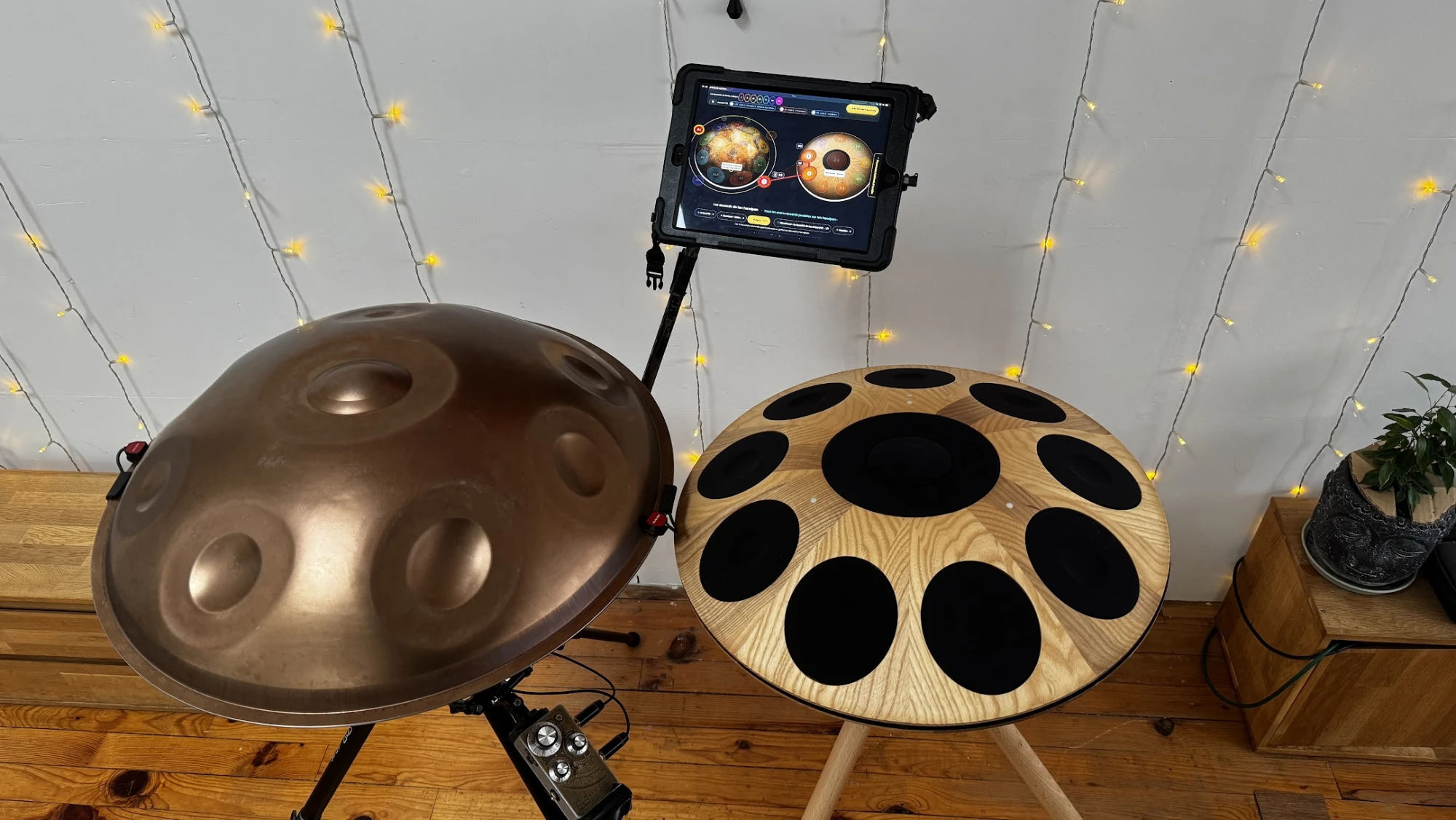
How can a Neotone 19 Mutant electronic handpan complete my acoustic handpan and unlock the 24 possible keys that would let me play the whole world repertoire of music and stop going round in circles?
This article is about an acoustic handpan completed by an electronic handpan. It’s a case specific to that pair: what follows is possible neither with two acoustics nor with two electronics.
That’s my question, and I’ve finally been able to answer it with figures rather than a hunch. Every figure below comes from replaying the real functions of Handpan Constellation Studio on the real notes of the instruments — the same engine that works out what appears on screen when you load your scale. None of them is an estimate, and each one is defined before it’s announced.
A word about the example first. I’m lucky enough to have an eighteen-note pan with plenty of low notes. That isn’t your situation, and it isn’t most people’s. The vast majority of players have a nine- or ten-note D Kurd — the best-selling scale in the world — and that’s the one you go round in circles on. So that’s the one I’m taking as my main example.
The D Kurd 10, and the wall everyone knows
An acoustic handpan is a hammered instrument. Each tone field is a note, decided once and for all, in a place imposed by the physics of the shell. That’s what makes it beautiful, and it’s also what makes the wall.
Here is the D Kurd 10 as it exists: D₃ · A₃ · B♭₃ · C₄ · D₄ · E₄ · F₄ · G₄ · A₄ · C₅. Ten notes on the shell, but only seven different pitch classes out of the twelve in music — the rest are the same notes an octave apart. And one thing you notice straight away when you see it written out: there’s nothing below the D₃. No bass. The instrument begins where a lot of songs would like to lay their foundation.
Now let’s set the definition down, because a number without its definition isn’t information:
A key is “complete” when its seven degrees are playable — when you can lay down, on the instrument, the seven chords that make it up. And the 24 keys are the 12 major ones plus the 12 natural minor ones, counted separately.
With a D Kurd 10 on its own, 2 of the 24 are complete: F major, and D minor. And those are in fact the same seven notes read two ways — in other words, you have just one tonal area. The other 22 have a hole in them. In chords, that comes to 6 major or minor chords out of the 24.
(A small note for anyone comparing with the screen: the app sometimes shows this same fact out of 12 — it then groups each tonic together and only calls “complete” the one whose major and minor both are. On that count, the D Kurd 10 alone is at 0 out of 12, and the completed acoustic at 12 out of 12. Same reality, two denominators. Here I’m counting out of 24, as in my original question.)

You don’t go round in circles out of laziness. You go round in circles because the circle really is small.
What an electronic pad does that a hammered note can’t
On an acoustic handpan, you don’t get to choose the notes freely: the size of the tone field, its place on the shell, its distance from its neighbours — the metal constrains all of it. That’s why nobody builds a chromatic handpan.
A Neotone doesn’t have that constraint. Its pads are sensors: any note can go on any tone field. So you can put exactly, and only, what the acoustic is missing on it.
That’s what I call completing your acoustic, and the words are precise: an acoustic handpan completed by an electronic handpan. Two electronics don’t make one. Nor do two acoustics — that’s an acoustic duo, a different thing, with qualities of its own. Here you get the gesture and the timbre of the acoustic, plus the notes it can’t carry.
The acoustic loses nothing: it stays exactly what it is, and you go on playing it.
On a D Kurd 10: what the engine works out
The app takes the real notes of the scale, looks for the missing ones, and picks the ones to put on the Neotone by ranking them by what they bring in: at each round, the note that adds the most chords across the two instruments together.
On a D Kurd 10, five notes are missing: C♯, D♯, F♯, G♯, B. Here’s the before/after:
| D Kurd 10 alone | + a Neotone | |
|---|---|---|
| Different notes (out of 12) | 7 | 12 |
| Complete keys (out of 24) | 2 | 24 |
| Major and minor chords (out of 24) | 6 | 24 |
| Chords with their root in the bass | 5 / 24 | 22 / 24 |

The circle of fifths stops being a textbook diagram. It becomes something you travel through: you modulate, you transpose a song so you can sing it, you accompany someone in their key instead of asking them to come into yours.
But the real question isn’t “do I have all the notes?”
This is where the story gets interesting, and it’s the point I hadn’t seen at the start.
When you accompany yourself while singing, you don’t play block chords: you play arpeggios. And an arpeggio that stands up is four notes — the root in the bass, the third, the fifth, then the octave above. That’s the movement that makes an accompaniment breathe instead of trudging.
But being able to do that isn’t enough on its own. There also have to be notes left available above to place a melody, an answer, an ornament — while the voice sings. An instrument where the accompaniment eats the whole register leaves room for nothing else.
So let’s measure it. How many chords, out of the 24, can you play as a full arpeggio — root, third, fifth, octave, in one gesture?
| D Kurd 10 alone | + Neotone¹ (10 notes) | + Mutant (19 notes) | |
|---|---|---|---|
| Available pitches | 10 | 20 | 25 |
| Range | D₃ → C₅ | C♯₃ → C₅ | C♯₃ → B₅ |
| Full arpeggios (out of 24) | 2 | 12 | 14 |
| Pitches left above the accompaniment | 5 | 10 | 15 |
Two. On a D Kurd 10 there are only two chords you can arpeggiate in full — C major and A minor. That’s it. And neither of them is D minor, the chord the scale is actually named after.

Put that into a real situation. You want to sing a song in D major. On your D Kurd 10 the D major chord doesn’t even exist: you’re missing the F♯. Add the Neotone and not only does the chord exist, you can arpeggiate it in full: D₃ in the bass (on your pan), F♯₃ (on the Neotone), A₃ (on your pan), D₄ at the octave — one gesture, both instruments. And once that arpeggio is laid down, you still have 9 pitches above it to sing over and answer the voice with. With the Mutant you have 14 left, and the range climbs to B₅: you can place a melodic answer above your own voice, not just inside it.
That’s the benefit of a wide register. It shows up in no count of keys at all.
The app already knows this problem: chord voicings
This isn’t an idea I’m bolting on afterwards — it’s already in the app’s Logic Mode, under the name chord voicings (Dispositions d’accord, formerly “Vocal Layout”). It offers three ways of spreading the same scale across the instrument, chosen according to your voice:
- 🌑 Deep — C₂ → G₄. Warm bass, woody tone. Made for high voices: the singing floats above the low end.
- ☀️ Bright — C₃ → G₅. Upper-middle register, clear and airy. Made for low voices: the instrument sparkles above the voice.
- 🌈 Wide — C₂ → G₅. The bass stays down low, the extensions climb right to the top, and a gap opens up in the middle — exactly where a mid-range voice comes to rest.
Look at how that’s built: seven bass notes, seven at the core, five in the extension. Nineteen positions. That’s the very structure of these three voicings, and it asks for nineteen tone fields. On ten, you can’t lay down all three storeys.
That’s the most honest argument for the Mutant, and it isn’t an argument about notes: it’s an argument about room.
Changing colour: a D Kurd that turns oriental
Something else you don’t expect, and which has nothing to do with keys.
A D Kurd is a colour: melancholy, round, western. A Hijaz scale — the oriental colour, the one with the flattened second degree and the augmented second — is an entirely different emotional world.
Let’s compare the two scales note by note. The D Kurd carries C, D, E, F, G, A, B♭. The D Hijaz in the catalogue carries C, D, D♯, F♯, G, A. So to play Hijaz you’re missing D♯ and F♯. Two notes. Two pads.
And here’s the loveliest part: those two notes are already part of the automatic completion. The five notes the Neotone adds to open up the 24 keys — C♯, D♯, F♯, G♯, B — include D♯ and F♯. In other words, the same second instrument that opens the repertoire to you also hands you, asking nothing more, an oriental colour your pan could never produce. You simply stop striking the E, the F and the B♭ of the acoustic.
A second-hand Hijaz handpan costs a whole instrument. Here, it’s two pads you already own.
Neotone¹ or Mutant: the difference isn’t where you’d think
This is the point where I expected to find a clear gap, and where the figures contradicted me. So let me say it straight.
A D Kurd 10 is missing five notes. The Neotone¹ has ten tone fields, the Mutant has nineteen. Five fit into ten. Both models therefore open up the 24 keys, and the 24 chords. The Mutant doesn’t open up more: there aren’t any more.
I checked that this wasn’t a quirk of this one scale: across the 74 scales in the app’s catalogue, the sparsest carries four different notes out of twelve — so at most eight are missing, and eight still fit into ten tone fields. The 10-note Neotone¹ fails on none of them.

What really separates the two models is the register — and behind the register, two very concrete things.
① The bass. A chord “has its bass” when you can put its root lower than its third and its fifth: the note that gives the chord its name is the one you hear underneath. Without it the chord still sounds, but inverted — it floats, it doesn’t settle. On my E 18, the Neotone¹ gives 23 of the 24 chords with their bass, the Mutant gives all 24: the gain, on my scale, is a single chord. On my D Kurd 18 it’s 21 → 24. And across the whole catalogue the Mutant does strictly better on 66 scales out of 74 (level on 8, never worse), with the average going from 19.2 to 22.7 chords with their bass out of 24. But on the D Kurd 10 taken as the example here, the two models are level — 22 out of 24: the bass settles nothing, because the automatic completion starts just below D₃ in both cases. One more reason not to buy the Mutant for the bass without having looked at your own scale first.
② The room above. That’s the one that counts most if you sing: 10 melody pitches against 15, and a whole extra octave at the top. It’s what the three-band diagram above shows.
So: if the goal is “have the twelve notes and open up the 24 keys”, the Neotone¹ is enough — and it’s worth knowing that before buying, because the gap between the two models is €1,160. The Mutant doesn’t buy you extra possibilities: it buys you what you need to accompany yourself singing while keeping room to play. It’s a trade-off about playing, not about notes.
What it costs, and what it doesn’t do
It’s a second instrument, so it’s a purchase. In the shop, the Neotone¹ starts at €1,990 and the Mutant at €3,150; the details of the editions and the calculator are on the Neotone page. This isn’t an accessory. It’s a decision.
And three limits, plainly.
Automatic completion fills in the notes that are missing, not the octaves that are missing. On a D Kurd 10 the Neotone starts at C♯₃ — just below the acoustic’s D₃ — and goes no lower, because no note is missing down in the bass, only pitches. If you want real bass under your D Kurd, you have to build the Neotone by hand: the app lets you put any note on any pad, and that is precisely where nineteen tone fields beat ten.
Having all the notes doesn’t make everything easy — it makes everything possible, which isn’t the same thing. A scale is a constraint, but it’s also a map: it tells you where to go. Once you have the twelve notes, that map disappears. A lot of people feel less good right after moving to two instruments, and it isn’t them going backwards: it’s their frame that has evaporated. The app walks you through that moment instead of pretending it doesn’t happen.
“The whole world repertoire of music” is a turn of phrase. What the figures say exactly is: the 24 major and natural minor keys are complete, and the 24 major and minor chords are playable. That’s the harmonic bedrock of the overwhelming majority of songs. It says nothing about non-tempered scales, about microtones, or about whether a playable chord is necessarily comfortable under the hands.
Where you can watch this happen
Everything written here comes out of the app’s engine, replayed on the real notes — so you don’t have to take a promise on trust. It’s in Handpan Constellation Studio, which opens at play.handpanstudio.app, and acoustic mode with scale completion is free.
If you’d like to try an acoustic and a Neotone side by side before deciding between the two models, you can at the showroom. And if you’d like us to explore this together, my lessons are open.
My goal has never changed: to accompany myself on the handpan like a guitarist or a pianist. An acoustic completed by an electronic is the first moment when that becomes literally true.
Ready to make your colours sing?
Try the app for free, or discover the electronic Neotone handpan.